

Ingrid Goes West: Why Is Ingrid A Great Character?
- Collin R. Vogt
- Sep 3, 2017
- 7 min read

Image via Movie Hole.
Ingrid Goes West is a dark, satirical, and engaging film. I would hesitate to call it a comedy, though. It’s funny, at many points, but humor is not the film’s goal. It goes to some very dark places, but without the “wink-wink” self-awareness of the black humor that, for example, It’s Always Sunny in Philadelphia has. The main reason for this is that the characters feel like real people, which is uncommon for a satire.
Ingrid Thorburn is taken seriously as a character. This elevates Ingrid Goes West as a film in general, but restricts it as a comedic satire. Through its treatment of her as a real person, the film forgoes many opportunities to push its humor, while overall making it more engaging to the audience.
The scene where Ingrid kidnaps Taylor’s dog Rothko is a prime example of this restraint. The act is not framed humorously, but desperately. There could have been hijinks of Ingrid trying to sneak into the house and bumping into shit, getting her pants caught in the window frame as she tries to climb through, like when Tobias Funke attempts to rob Julia Louis-Dreyfus’ “blind” character’s house in Arrested Development, or when the gang misguidedly breaks into a nearby families house for an extreme makeover in It’s Always Sunny. But instead, she merely walks up to an open window and lures the dog over with an In N’ Out burger patty.
A similar scene in a funnier context.
The difference here is that these characters are absurd. They are not the result of the satire, they are the satire itself. The audience is not really invested in their fate and the humor is a result of our perceived superiority relative to them. They are caricatures more so than characters.
Additionally, we know that Ingrid’s behavior has gotten her in serious trouble before, as we’ve recently seen her depart from a mental hospital as a result of previous obsessive actions. The decision to start the movie with this confinement and subsequent release grounds it in reality. There are consequences. Watching Ingrid mercilessly spray mace in the eyes of her “friend” is not nearly as funny when you’ve just seen her sobbing uncontrollably in her car and then being placed in a hospital afterwards. Because the first thing the audience sees is Ingrid in emotional pain, she is granted our sympathy. All of this serves to limit much of the films humor to a knowing chuckle, rather than an outright laugh.
But neither does to film play out as a frightening thriller, as in Fatal Attraction. Because we’ve started the film having seen Ingrid’s perception and pain, we know that her intention is not to inflict pain. That is only a result of her emotions, which is something everyone can relate to. We’ve all wanted to punch someone, but we have the mental fortitude to resist, and the fact that Ingrid cannot further enhances our sympathy for her. We’ve seen her crying, laughing, sitting on the toilet, and crying and laughing whilst sitting on the toilet. The sadness present in the character makes her feel less dangerous and warms her to the audience.
The trailer for Ingrid Goes West.
By perfectly balancing between the two poles of Comedy and Thriller, Ingrid Goes West conjures the perfect element for a satirical film: personal investment. You care for Ingrid’s well-being, and she is a sympathetic character because her misdeeds are not enacted out of malice, but desperation and sadness. Dramatic Irony can produce sympathy, because the audience is aware of the futility of the protagonist’s actions. It allows us to see the characters values more clearly because we already know that they will not be successful. We know Ingrid will not develop the relationships she craves through social media, so her attempts to encourage us to feel for her and look beyond the results of her actions and more about the reasons for them.
In fact, Ingrid is presented as quite a child-like character. She comes off as a twelve-year-old who wants to hang out with her older sister and her friends and forces herself to laugh when they make fun of her – she doesn’t even know why she’s doing it, and if she had the clarity to see that she doesn’t want friends who mock or abuse her, she wouldn’t even bother. This inspires empathy.
Ingrid’s clearest personality trait is naivete, demonstrated by a quid-pro-quo, favor based concept of relationship and her inability to convincingly mirror the “personality” of Taylor, the object of her obsession. Her attempts to mimic her appear contrived – not that Taylor is capable of noticing – because she has no sense of self. She has no reference point to create a fake personality because she doesn’t have one of her own. It’s all based on imitation. It’s like trying to move muscles without bones for them to pull against. It’s like she’s the Ditto Pokemon, an amorphous blob, who can only take the shape of other Pokemon.
Her obsessiveness should as obvious to the other characters as it is to us, but none of the characters are aware enough of themselves or the world around them to see anything more than her most superficial qualities, which are the most easily faked.
The other characters only see Ingrid as a frame for themselves. Taylor, played by Elizabeth Olsen, sees an acolyte, a disposable friend to binge on and impulsively consume so intensely that no potential conflicts are recognized until they explode. Can you tell me you don’t know people like that?

Aubrey Plaza as Ingrid Thorburn.
Dan, played by Ice Cube Jr. (Ice Square? Shaved Ice?), is her landlord and potential love interest. He sees her as an object of desire, but not because of who she is as a person. More than anything, it’s because she’s so empty that she serves as a mirror to see himself in. She’ll become whoever he wants to get whatever she wants. His interest in her is communicated wordlessly, by his instant following of her on Instagram as soon as leaving the room after first meeting her. He’s willing to be abused by her for a disproportionately low amount of affection.
Nicky, Taylor’s sociopathic brother, portrayed by Billy Magnussen, has the simplest intentions for Ingrid: good-old-fashioned extortion. His desire is simple because he is simple as a character. He is a foil for Ingrid. While Ingrid’s actions are motivated by desperation and sadness, Nicky’s are motivated out of greed and selfishness. While his actions may not be quite as extreme as Ingrid’s, the fact that they come from a much darker place emotionally still presents him as the closest thing to an antagonist in the film. More on that in a bit.
Am I justifying Ingrid’s actions more than she deserves? Maybe. The point is that the movie is very adept at making you want to do so by treating the character with compassion, and as a lens through which we can view the satire, not merely as the object of the satire, which would make the film significantly less emotionally engaging.
The advantage of this personal investment is that the audience can apply the satire to themselves. You could not imagine being Patrick Bateman, from American Psycho, but you could imagine being Ingrid Thorburn. And while American Psycho is a great film for many reasons, it doesn’t really present itself as having anything for the audience to learn that they don’t already know. Its purpose is about the spectacle and enjoyment of the film rather than having a non-obvious moral statement.

Ingrid and Taylor, posing for a gram.
There is nothing subjective about Patrick Bateman. He’s a monster, plain and simple. But what do you really learn from monsters? That you revile them? Sure, and that’s what some movies are for. But Ingrid Goes West is a great film because it is incredibly nuanced.
Consider this: if the story were told from Taylor’s perspective, Ingrid would without a doubt be the villain, terrorizing and stalking our likable and pretty protagonist. But instead, you’re on Ingrid’s side, rooting for her – although, not to get what she thinks she wants, but to grow enough to understand what she’s really looking for, which is to be loved.
You want her to learn and develop as a person, and by extension, this encourages the audience to look inward. What is it about themselves that tells them Ingrid’s path is the wrong one, but which insists that deep down she’s a sympathetic character? It’s our realization that it’s all too easy for us to fall into the same traps of virtual obsession and pedestal-setting. The only thing separating us from her mistakes is a slightly more stable psyche, but even that is less secure than we’d like. Ingrid is a great character because she both inspires compassion and gets us to reflect on why her choices are misguided and even unethical. Yet the film always makes sure to keep her from becoming too unlikable, which would have the opposite effect. Ingrid Goes West is incredibly well balanced and nuanced which allows its satire to be that much more effective and personal. And all those qualities are achieved through Ingrid’s character.
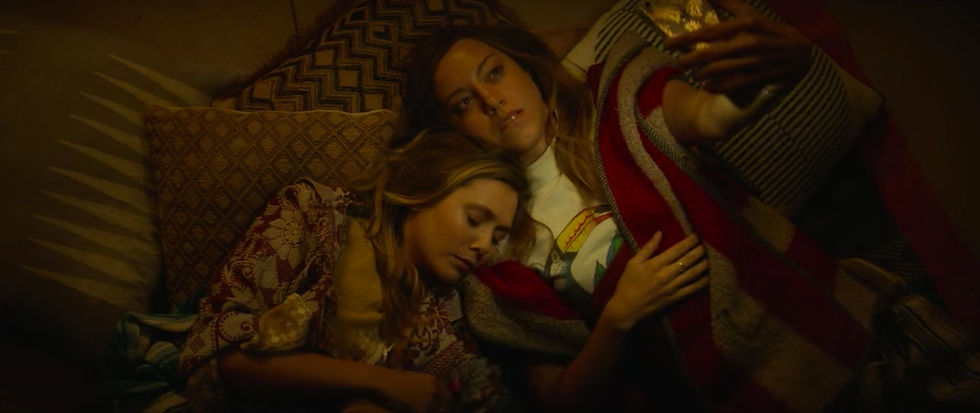
Probably the greatest moment in Ingrid's life.
One thing about the movie that I initially disliked was the soundtrack. I thought it’s peppy, upbeat and expansive tone was entirely wrong for the theme of the movie and Ingrid’s character, in that it seemed to portray a sense of childish wonder. The soundtrack is an important but often improperly utilized piece of a film, and I was disappointed that this seemed to be the case here.
However, I began to realize that the soundtrack was being used not to portray the themes of the movie, but instead Ingrid’s actual mindset and emotions. Her naivete and innocence were being echoed in the music, and is well-matched with images of her on the beach, clutching her phone lovingly to her chest when Taylor tags her in a post or replies to her on Instagram. The music is being used to establish a cognitive dissonance between Ingrid’s emotional state and our perception of what is normative.
This realization gained the film my complete trust. I was able to be more immersed because I knew the music was not just describing the tone of the scene, but instead how Ingrid was feeling internally, and this disparity between reality and perception is a major theme of the film, being expertly reproduced and emphasized in the music. It’s not telling the audience how to feel, it’s letting them use the information to extrapolate a meaning. That’s a lot of trust to put in a modern audience.
Ingrid Goes West is director Matt Spicer’s feature length debut, which is very impressive. He was able to utilize virtually every aspect of the film to emphasize it’s themes, and strengthen the character of Ingrid, and I’ve already said all I need to about why she’s such an effective and important character.
Go see this movie. Just don’t look at it as superficially as any of its characters would. The good stuff is just beneath the surface.


Comments