

Putin's Proxy War
- Collin R. Vogt
- Apr 17, 2017
- 12 min read

The Vlad. Image by Antoine Gyori/Sygma/Getty Images.
People have been freaking out, more or less understandably, about Trump’s recent use of force, being the launch of 59 Tomahawk missiles, at the Al-Shayrat Airfield, which was supposedly the source of the chemical weapons recently used on a civilian population in Syria.
But I don’t think this is the start of WWIII, and I don’t think this is the start of Iraq 2.0. This recent strike is an extremely nuanced and complex situation, the progenitors of which can be traced back as far as the dissolution of the Romanov dynasty in Russia and the establishment of “communism” – which was actually socialism – the results of the Bolshevik revolution towards the end of the first World War. But I won’t go back that far, only to say that the establishment of communism and the centralization of power in Russia is nothing new.
The first thing I want to talk about is Russia’s clandestine invasion of Ukraine in 2014, an act which they initially attempted to deny, although which now is quite apparent. This event, I feel, is the start of the current tensions between the US and Russia.
Obama, and the UN along with him, enacted heavy sanctions on Russia in response to these actions, but predictably, they continued. I generally resent the imposition of economic sanctions in response to military actions, particularly on countries that are already poor. The reason for this is that it basically has the opposite effect that is intended. I was a huge fan of Obama thawing tensions with Cuba, and no, it’s not because I see Che Guevara and Fidel Castro as defenders of the working class or whatever Jill Stein said about the bloodthirsty pair of revolutionaries. It’s simply because countries change when their economies flourish, and they become more entrenched when they are impoverished. Poor nations categorically suffer from lower literacy rates, centralized and powerful governments, and famine.
This, in turn, keeps the population easier to control and at the mercy of the government.
A prime example of this is the difference between China and North Korea. China, although still heavily agrarian and with a GDP per capita that isn’t even half of the US’s, is a vastly richer country than North Korea, and you can see the result of this in the liberalization of their economy. Although their general financial regulations are still controlled by the government, their tactics are quite similar to Western countries going through an economic boom, like, for example, the devaluation of their currency in an effort to bring more and more business to their country. Their citizens enjoy increasing luxury and levels of freedom and self-expression that were previously harshly repressed. Prosperity brings liberalization, education, and individuation – important factors for free countries.
Compare this to Korea. Due to the nearly universal economic sanctions placed on trade with North Korea, they are perhaps the most impoverished and famine-ridden country on the planet, at least that cannot yet be considered a “failed state” such as Somalia. Has the impoverishment of their people led to a regime change and liberalization from the inside out, as was the hope? Obviously not. Kim Jong-Un is more entrenched than ever, and unfortunately, is an even less stable leader than his father. Hundreds of thousands of North Koreans are dead as a result of starvation, and who knows how many more at the hands of the government itself?
The divergent fate of these countries is quite telling, as they were not that dissimilar at the time of Korea’s division, both probably being considered third-world countries at the time of the Korean War. Even more so is the difference between the North and South of Korea itself, although I didn’t use South Korea as an example because they are considered an ally, and our relationship with China is far more ambiguous. My reason for using China is to show how, despite being politically unaffiliated with them, by not using sanctions and instead creating prosperity, China has begun to liberalize and bend to the influence of their increasingly educated population.
Now the other part of the problem with the “sanction game” is that I doubt that anyone who has ever earned an economic embargo from the United States has had what can within the realm of reason be called a free press. In fact, in the case of Russia, the press is undoubtedly under the control of the Kremlin.
What do you think is reported in the news when the US sanctions trade against Russia? Do you think their journalists are calling out Putin’s misdeeds, demanding that he do whatever possible to reestablish this vital trade relationship, and not let his country starve and regress economically? No, of course not. Not only is this information not being accurately reported, it is likely being twisted to show that the US is deliberately trying to weaken Russia, out of hate, fear, or filthy capitalism.
Furthermore, if you think Vladimir Putin gives a damn whether or not his people are hungry, much less happy, then you are dangerously naïve and should probably withdraw from society. I’m kidding, but make no mistake, this guy gives about as much of a shit about his people as Stalin did, which, based on the fact that Stalin killed millions of them, means not very much at all.
More than anything, a communist regime needs an exterior antagonist upon which they can focus their efforts and anger. This placates their population and both redirects their anger away from the government and actually imbues them with a sense of national pride and resiliency, despite their impoverishment.
My point boils down to this. Sanctions and embargos are what rich, free nations think is the worst punishment they can dole out because they think everyone approaches governance the same way. In many cases, it actually creates a stronger government in the country you are trying to create an economic revolution in. It’s like putting pressure on a piece of coal, hoping it’ll turn into a diamond, but it turns out it’s not actually a piece of coal. It’s just some bullshit rock.
This is why I was a fan of Obama’s foreign policy in regards to Cuba and utterly baffled as to why he wouldn’t apply the same logic abroad. Even a broken clock is right twice a day, I guess.
Despite Obama’s excessive use of drone strikes, he was actually quite weak in his foreign policy. In fact, at nearly every turn, with the notable exception of Cuba, Obama’s foreign policy was a complete and utter failure. More than a failure, it seems as though his foreign policy was based on an inability to understand different cultures and the place America currently occupies on the world stage. Obama wanted the other members of NATO to be equal partners in any overseas intervention.
That is literally never going to happen. France, Germany, and Britain are never going to act without the US intervening first. Like it or not, we are the military power of the west, and we should act like it. Obama’s apologism and seeming unwillingness to tarnish his reputation with actual boots-on-the-ground military intervention are, in my opinion, the root cause of the mess that is Syria right now. And it goes back to Ukraine.

Ukrainian soldiers in eastern Ukraine, image via Ministry of Defense of Ukraine
Ukraine was little more than a test of Russia’s ability to extend itself. It was Putin dipping his finger into the waters of expansionism. And apparently, he found the those weren’t so cold anymore. The West’s Paper Tiger in chief imposed economic sanctions on a country whose leader does not care about the economic status of his people. In fact, it worked to his advantage, giving him fuel for the fire of anti-western sentiment that has been brewing in Russia for years.
The failure to act in Ukraine (and, tangentially, in the South China Sea) is a foreign policy debacle basically on par with allowing Hitler to take the Rhineland in the preamble to WWII. And, allowing him to continue intervening in the Middle East, is akin to allowing Hitler to take Czechoslovakia. And I believe Turkey will be the Poland, the inciting event over which the Allies could no longer deny Hitler’s intentions. At that point war was unavoidable. Many may say that WWII was a foregone conclusion regardless, but I disagree. Intervention in Germany’s expansion as early as their foray into the Rhineland may have defused the situation altogether.
The reason for this is the flawed logic that a small use of force will only cause escalation, when it could, in fact, cause a dictator, sitting on an unstable regime of poverty, ignorance, and nationalism, to crumble. This is, ironically, exactly what happened to Russia in WWI. Russia, while poorly equipped and not as technologically advanced as Germany, was not undone militarily, but politically. Without getting too far into it, the leader of Germany’s military returned Lenin to Russia to destroy the Romanov dynasty, so that Russia would withdraw from the war and the forces on the Eastern front could be repositioned to the much more gridlocked Western front.
Anyways, back to 2017. My interpretation of Putin’s involvement in Syria is that this is not his endgame, not even close. His gaze is set on Europe, and he plans to extend his influence on it via Turkey.
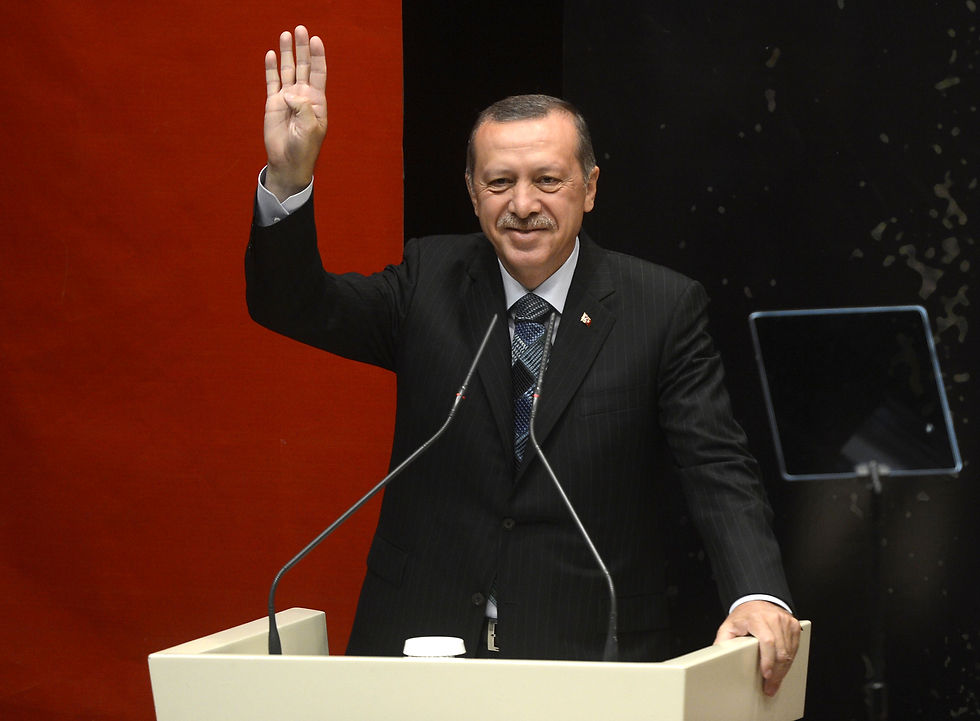
Recep Tayyip Erdoğan, President of Turkey
If the Middle East is a hurricane, you might call Turkey the storm’s eye. It is far more stable and liberal than most other powerful Middle Eastern nations, aside from the United Arab Emirates, which, although wealthy, is hardly a political player on par with Saudi Arabia, Iran, and Turkey.
Turkey has always been a contentious area, dating as far back as the Roman Empire, where Constantinople (modern day Istanbul) was named the new capital of the Roman Empire by Constantine, which became the new political epicenter after the fall of the Roman Empire, as well as the source of Orthodox Christianity, to which the Catholic church was opposed, culminating in the Fourth Crusade, one of the primary events of the Great Schism between the Eastern and Western Catholic churches. Centuries later it became the Ottoman Empire which collapsed at the end of WWI with the Allies occupying and partitioning it.
You can see what I mean when I say this region has been contentious, even by Middle East standards. I think that this was an extremely detrimental and destabilizing event, the results of which are still obviously being felt today. It’s no secret that the Allies essentially assured WWII with their unreasonable resolutions at the end of the Great War. Think of how the reparations forced on Germany ultimately led to Hitler’s rise to power and the countless deaths that resulted from it. The situation created by the partitioning of the Ottoman Empire is quite similar, although people are far less aware of it, as it’s taken quite a bit longer for that pot of water to come to boil. But the Allies essentially cut the heart out of the Middle East, dissolving it’s political and culture center and allowing the rest to squabble over the bones. Undoubtedly, it set the region back decades.
The Arab nations have been besotted more than once. In the 10th and 11th centuries, Islamic culture was the second most advanced civilization, aside from China, and Baghdad was its crown jewel. Until Genghis Khan.
Genghis is quite possibly the biggest political destabilizer in history. He conquered China, Russia, and Eastern Europe, but the worst offence of the Mongol Empire was the decimation of Baghdad, and with it, Islamic culture. This event is marked as the end of the Islamic Golden Age, and set Islam back centuries, and I would consider the fall of the Ottoman Empire to be similar in its detrimental effect on the stability of the region.
What happens when you destabilize a culture? You get dictators. This is, as I said before, why I am against the use of trade embargos and sanctions. Weakened and destabilized cultures consistently fall prey to strongmen and dictators. Stalin, Mao, Hitler, Castro, Caesar…the list is as old as history. Humans crave stability more than they do moral righteousness, unfortunately. Milgram’s classic experiment is proof enough of this idea. We have to work within the restraints of human nature. Although I admire President Obama’s idealism, I feel that his responses, or lack thereof, is a failure of pragmatism more than anything.
Putin doesn’t care about Bashar Al-Assad. He doesn’t even care about the people of Syria. What Putin really cares about is destabilizing Europe, specifically the NATO alliance. And to do that, he needs allies of his own. Enter Erdogan.
Is it any surprise that after Russia became involved in Syria, Turkey softened its stance on Al-Assad? No, of course not. Putin is putting his hands over Erdogan’s neck through Bashar Al-Assad. Syria has been a thorn in Turkey’s side for years, and this is why the west’s failure to act is so problematic.

Vladimir Putin and Bashar Al-Assad. Image via Пресс-служба Президента России (Press Service of the President of Russia)
Putin is attempting to exert control over Erdogan through his relationship with Bashar Al-Assad. The message he seems to be trying to send is that he’ll support strongmen, but he’s at the top of the pyramid. Kind of like when Xerxes offers to make Leonidas the warlord of Greece. Furthermore, by backing Al-Assad, he is ensuring that all negotiations between him and Turkey will essentially be under his control. It’s a complex situation; Putin seems to be offering a double-edged sword, as he is wont to do. Putin specializes in domination via the velvet-gloved iron fist.
Erdogan has become increasingly at odds with Europe due to his intolerance for free speech and unwillingness to cooperate with European Union standards. Putin saw his opening. He has now effectively placed Erdogan between a rock and a hard place, and the problem is, Turkey has a lot more to lose by refuting Putin’s advances. Before we even consider the political environment, it’s important to realize that Turkey is far more reliant on trade with Russia than the EU is. If they can’t turn to Western powers for support, they will likely feel submission to Russia is inevitable.
Another wrinkle in this situation is ISIS, which has become quite the useful political tool, hasn’t it? Anyone can justify anything as long as ISIS is around. Putin is offering Erdogan the veneer of a military alliance by cooperating with Turkey and Al-Assad in opposing ISIS. However, until 2017, Erdogan wasn’t anywhere near an alliance with Bashar Al-Assad, and wanted him removed just as bad as Isis. Putin is basically saying that ISIS is the real threat, and as long as Turkey abides by Bashar Al-Assad, they’ll have Russian support against ISIS. Or, more accurately, they won’t have a problem with Russia. There’s no reason for Turkey to cozy up to Al-Assad, except for the now obvious threat of Russian intervention against them. The only problem is that ISIS is a fading threat, and Erdogan may come to regret supporting Al-Assad, and through him, Putin, against a threat that is not quite as dangerous as he thought.
This is why I think Trump’s missile strike is the right call. Putin’s militaristic influence has gone unchecked for years, and he has only gained momentum. A regional dispute over the Ukraine and Crimea is murky, but Russia’s incursions in the Middle-East are much more cut and dry. This missile strike is only tangentially related to Bashar Al-Assad and ISIS. It’s really about Russia, Turkey, and the future of Europe. Although Trump has made disparaging remarks about NATO, this action flies in the face of those comments, to my relief. By targeting Syrian military targets, it’s easy for Trump to deny direct action against Russia. These tactics are nothing new, of course, lest we forget the Vietnam war.
By intervening, Trump has, intentionally or otherwise, relieved pressure on Erdogan, and even more importantly, on the people of Turkey.
As of yesterday, Turkey held a referendum (you remember, the brilliant device behind Brexit) on whether or not to establish Erdogan as an “executive president” abandoning their parliamentary system, and he won with 51.4% of the vote, although the results have been met with resistance, as up to a third of the votes are in question due to the fact that country’s election board announced it would accept unstamped ballot papers, which leaves the veracity of the results open to doubt. Remember what I said about people needing security first, and morality second. This referendum is a macrocosm of the very relationship between Erdogan, Putin, and Al-Assad. Erdogan, while not happy with Al-Assad, will side with Putin against what he perceives as the more immediate threat. So too will the people side with Erdogan, an indisputably strong leader, though not a righteous one, against the more immediate threat.
But with this missile strike, Trump has essentially said we’re willing to get involved to undercut Putin’s presumed international military primacy. Erdogan is not a good president. But at least he is elected, and can be removed from office in the future, unlike Putin, who, while “democratically elected”, is in effect a dictator.
This is what it boils down to: This missile strike, and America’s interventionism in general, is important to secure NATO and the future of Turkey, and, by extension, the future of Europe. If Russia’s influence can be contained in Syria, then Europe has some breathing room. Although I am disappointed by the results of the referendum (questionable as they are), my hope is that the Turkish people will reduce Erdogan’s political dominance.
Turkey is a powder keg. Syria is an example of what happens when a powder keg goes off.
Supposedly, Russia was informed of the missile strike before it happened, and Russia in turn notified their allies, who were able to avoid maximum casualties. The impotent, bushy browed, and effete Keith Olbermann, host of the arrogantly titled The Resistance, a “news” webshow, who is seemingly unable to approach political analysis honestly and without enforcing his anti-Trump agenda, referred to this as “collusion with the enemy”, but I see it differently, naturally.
Blowing up hardware is one thing. Killing Russian soldiers is quite another. That would have been a complete disaster. I have no doubt that this is the purpose for which Russia was alerted. Not only would dead Russian soldiers have added to Putin’s stockpile of anti-west ammunition, but it would have been an unretractable action, one which could not be justified by Al-Assad’s use of chemical weapons, as the Russian military – supposedly – was unaware of this plan.
This strike was not meant to inflict casualties, but to make a statement. And I believe it was successful in that regard. Furthermore, I think Trump’s reputation as an unpredictable hothead, and as an unknown quantity, will serve him well in his interactions with Putin, if in nothing else.
It will be interesting to see what developments come of this. It is imperative to not abandon Turkey as an important ally, and Putin’s desire to control it cannot be understated. His thinly veiled attempt to extend his influence into this critical region, which has a foothold in Europe, Asia, and the Middle East, must be opposed.
Putin, while dangerous, is no fool. This is not the start of the next world war.
Kim Jong-Un, however, is a different beast. One I’ll tackle in my next article.


Comments